
How to Manage Products From Multiple Sporting Goods Suppliers
Learn how to organize wholesale product catalogs, manage inventory, update pricing, streamline dropshipping, and build a more efficient sporting goods business.
Managing Multiple Wholesale Suppliers: An Important Part of Growing Your Business
One of the greatest advantages of operating a sporting goods business is the ability to offer products from multiple wholesale suppliers.
Instead of depending on a single distributor, sporting goods dealers can work with different suppliers that specialize in baseball, softball, basketball, football, soccer, volleyball, team apparel, fitness equipment, and other product categories.
Having multiple supplier relationships may allow you to offer more products, serve additional customers, and expand your business into new sports markets.
However, managing these suppliers effectively requires organization.
Different distributors may use different product numbers, pricing structures, inventory updates, shipping procedures, and ordering systems.
The goal is simple: Build one organized sporting goods business while managing products and orders from multiple wholesale supplier relationships.
Whether you are an existing SportsLife member or someone researching how to start a sporting goods business, understanding this process can help you avoid costly mistakes.
Why Working With Multiple Sporting Goods Suppliers Is an Advantage
Relying on one supplier may limit the products you can offer your customers.
For example, one distributor may specialize in baseball and softball products, another may carry athletic apparel, and a third may offer football or basketball equipment.
Working with multiple suppliers can help expand your product selection without requiring you to manufacture products or purchase every item in advance.
More Product Categories
Offer products across multiple sports instead of depending on one category.
More Brand Opportunities
Explore recognized sporting goods brands available through approved wholesale supplier relationships.
Additional Inventory Sources
Multiple suppliers may provide alternative availability when a particular product is out of stock.
Business Flexibility
Expand into additional product categories as customer demand increases.
The key is selecting suppliers that complement your business rather than adding large product catalogs without a clear sales strategy.
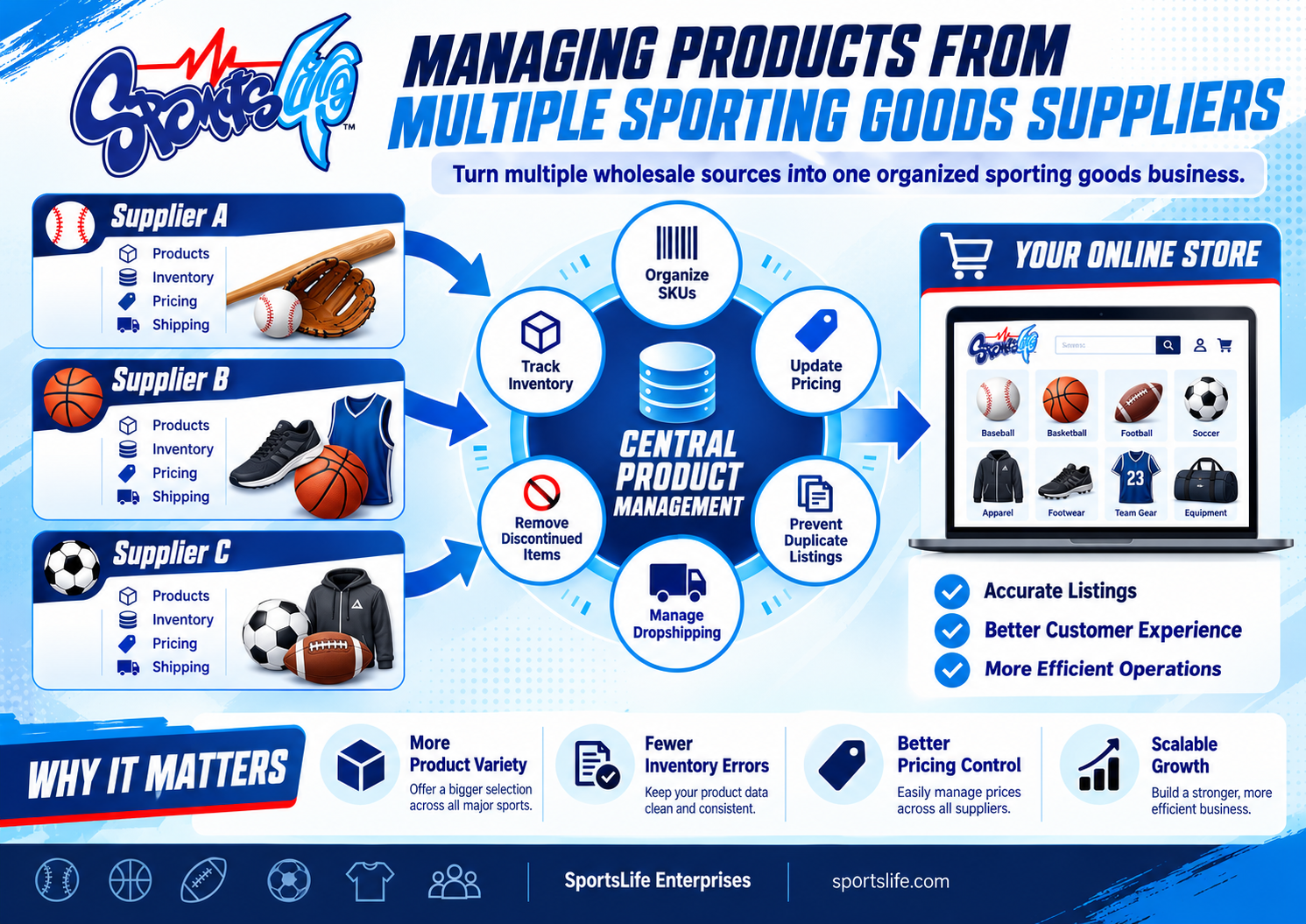
How Multiple Supplier Product Catalogs Work Together
Imagine running an online sporting goods store with three different wholesale distributors.
Each supplier provides its own product information, including descriptions, SKUs, wholesale pricing, inventory levels, and product availability.
Your job is to organize this information so customers see one professional store.
Organize products from several wholesale distributors through one centralized product management process.
Central Product Management
Organize SKUs • Update Pricing • Track Inventory • Manage Discontinued Products
Your Sporting Goods Website
One organized online store offering products from multiple suppliers.
This process may be performed manually through spreadsheets or managed using ecommerce software and automated inventory integrations.
The best approach depends on the number of products, your website platform, your supplier data formats, and how frequently inventory changes.
Organizing Your Wholesale Sporting Goods Catalog
Before importing thousands of products into your website, create an organized system for identifying and managing them.
Each product should ideally have accurate information for:
- Product name
- Product description
- Brand or manufacturer
- Supplier name
- Supplier product number
- Store SKU
- Wholesale cost
- Retail price
- Inventory availability
- Product images
- Product variations such as size or color
- Shipping information
- Discontinued product status
Why Product SKUs Matter
A Stock Keeping Unit, commonly called a SKU, is an identifier used to track an individual product or variation.
Sporting goods suppliers may use different SKUs for the same product, while different product variations may require separate identifiers.
For example, a baseball batting helmet may be available in several sizes and colors.
Your product management system should identify each sellable variation accurately so the correct inventory and pricing information is maintained.
Dealer Tip: Keep a record of both your internal store SKU and the supplier's product number. This makes supplier updates, ordering, and troubleshooting easier.
Keeping Supplier Inventory Accurate
Inventory management is one of the most important responsibilities of an online sporting goods dealer.
A product listed as available on your website may already be sold out at the supplier.
If a customer purchases an unavailable product, the dealer may need to issue a refund, locate an alternative product, or explain a shipping delay.
Repeated inventory problems can damage customer trust.
How to Reduce Overselling
- Update product inventory using supplier stock files when available.
- Schedule inventory updates based on how often each supplier provides new information.
- Remove or disable discontinued products.
- Avoid displaying unlimited inventory for products with uncertain availability.
- Confirm stock availability before committing to large team orders.
- Consider a safety buffer for products with rapidly changing inventory.
No inventory system completely eliminates stock changes. However, regular updates and careful inventory management can significantly reduce problems.
Managing Wholesale Costs and Retail Pricing
Different suppliers may offer different wholesale costs for similar or even identical products.
Dealers should not assume that every supplier provides the same pricing, shipping charges, or purchasing terms.
Before setting a retail price, consider:
- Wholesale product cost
- Supplier shipping charges
- Payment processing fees
- Packaging or handling charges
- Advertising expenses
- Potential return costs
- Minimum Advertised Pricing policies
Example: Understanding Your Actual Costs
Imagine purchasing a sporting goods product from a supplier for $60 and selling it for $100.
The difference is $40, but that does not mean the dealer earned $40 in profit.
| Item | Example Amount |
|---|---|
| Retail selling price | $100.00 |
| Wholesale product cost | -$60.00 |
| Shipping expense | -$10.00 |
| Payment processing | -$3.00 |
| Amount remaining | $27.00 |
In this hypothetical example, $27 remains before other expenses such as advertising, software, returns, labor, and taxes.
Important: Always evaluate actual landed costs and supplier pricing rules before deciding how to price products in your store.
Understanding Wholesale Supplier Product Feeds
Many sporting goods wholesalers provide product data files to help dealers maintain their catalogs.
These files may contain product names, descriptions, images, SKUs, wholesale pricing, inventory levels, and product status.
CSV Files
CSV files are commonly used to transfer product information. They can be opened in spreadsheet applications and imported into many ecommerce platforms.
Excel Spreadsheets
Some suppliers provide Excel files containing product details, inventory information, and pricing.
XML Feeds
XML files use structured data that can be processed by compatible import software.
API Integrations
An Application Programming Interface, or API, allows compatible systems to exchange information electronically.
Depending on the supplier and integration, an API may support product updates, inventory checks, pricing information, or order processing.
Dealer Tip: Before opening a supplier account, ask whether product data files, inventory updates, or API integrations are available.
Managing Dropshipping From Multiple Suppliers
Dropshipping can allow a sporting goods dealer to sell products without storing every item in a warehouse.
When a customer places an order, the dealer submits the order to the appropriate supplier, who ships the product according to its fulfillment policies.
However, working with multiple dropshipping suppliers requires additional coordination.
Multiple Shipments
A customer may purchase products from two different suppliers in the same order.
Those products may ship separately and arrive on different dates.
Different Shipping Charges
Suppliers may charge different shipping rates, handling fees, or dropshipping service charges.
Order Tracking
Dealers should maintain accurate tracking information for each shipment and communicate delivery expectations clearly.
Returns and Exchanges
Each supplier may have different return policies, return authorization requirements, and restocking fees.
Your store policies should account for supplier requirements while complying with applicable consumer laws.
Ecommerce Tools That Can Help Manage Multiple Suppliers
Several ecommerce platforms provide tools for managing products from multiple wholesale distributors.
WooCommerce
WooCommerce is a WordPress-based ecommerce platform that supports physical products, product variations, inventory management, and extensions.
Import tools such as WP All Import can help process product catalogs, update existing products, maintain inventory quantities, and manage pricing when configured correctly.
Dealers should ensure that product and variation identifiers are unique, supplier files are mapped accurately, and discontinued items are handled carefully.
Shopify
Shopify provides ecommerce management tools and integrations that can help maintain product catalogs and inventory.
Additional applications may be needed for advanced supplier feeds, order routing, and automated updates.
Other Ecommerce Platforms
Other website platforms may support catalog imports, inventory updates, and supplier integrations.
The most important factor is choosing a platform that supports your supplier data, product volume, and operational needs.
Best Practice: Test inventory and pricing imports with a small group of products before applying updates to your entire online catalog.
What Happens When Multiple Suppliers Carry the Same Product?
Sporting goods distributors sometimes carry identical products from the same manufacturer.
This creates an opportunity to compare wholesale pricing, inventory availability, shipping expenses, and delivery times.
However, it can also create duplicate product listings if the dealer imports each supplier catalog without reviewing overlapping products.
How to Handle Duplicate Products
- Identify matching manufacturer product numbers or GTINs when available.
- Compare wholesale costs and shipping expenses.
- Review supplier availability.
- Maintain accurate internal product identifiers.
- Avoid duplicate customer-facing listings unless there is a valid merchandising reason.
- Keep a record of alternative supplier sources.
A centralized catalog can make this process easier as your product selection grows.
Start With a Manageable Product Catalog
One common mistake new sporting goods dealers make is attempting to list thousands of products before understanding their target customers.
A large product catalog may appear impressive, but it also creates additional work.
Every product requires accurate pricing, inventory information, descriptions, images, and supplier tracking.
Instead of importing every available product immediately, consider starting with categories that match your business goals.
For example, a dealer who already works with youth baseball teams may begin with baseball equipment, training aids, team accessories, and apparel opportunities.
As the business grows, additional categories can be added gradually.
Remember: A smaller, well-managed product catalog can provide a better customer experience than a large catalog containing inaccurate information.
Already a SportsLife Member?
Make the most of your membership by reviewing the SportsLife Supplier Directory, comparing suppliers, and identifying the product categories that best fit your sporting goods business.
How SportsLife Enterprises Helps Aspiring and Existing Dealers
Managing multiple wholesale suppliers becomes easier when you have a clear understanding of the opportunities available to your business.
SportsLife Enterprises helps aspiring and existing sporting goods dealers access wholesale supplier information and business resources focused on the sporting goods industry.
Through SportsLife membership, dealers can explore supplier opportunities involving:
- Wholesale sporting goods products
- Recognized sporting goods brands
- Multiple sports categories
- USA-based supplier opportunities
- Dropshipping services where available
- Low or no minimum-order opportunities where available
- Team apparel and equipment
- Ecommerce business resources
Rather than spending time searching for supplier opportunities entirely on your own, SportsLife provides a centralized starting point for reviewing participating supplier information.
Each wholesale supplier determines its own account requirements, approval process, pricing, product availability, brand access, and sales policies.
Wholesale Supplier Management Checklist
Use this checklist to evaluate how effectively your business manages supplier relationships and product information.
- I maintain a record of my wholesale supplier accounts.
- I know which products come from each supplier.
- My store uses accurate product identifiers.
- I review wholesale pricing changes.
- I update supplier inventory regularly.
- I remove or disable discontinued products.
- I understand each supplier's dropshipping policies.
- I account for shipping and payment-processing expenses.
- I review marketplace and brand resale restrictions.
- I understand supplier return procedures.
Interested in Becoming a SportsLife Dealer?
Explore SportsLife membership packages and learn how access to wholesale supplier information, dropship-friendly opportunities, and dealer resources can help you begin building your sporting goods business.
Frequently Asked Questions
Can I work with multiple wholesale sporting goods suppliers?
Yes. Many sporting goods dealers work with multiple distributors to expand their product selection. Each supplier has its own account requirements and resale policies.
How do I keep inventory updated from multiple suppliers?
Inventory can be maintained using supplier spreadsheets, CSV files, XML feeds, APIs, and compatible ecommerce inventory tools. Update frequency depends on the information each supplier provides.
Can I dropship products from different wholesalers?
Yes, when the suppliers permit dropshipping. Dealers should understand shipping costs, order processing, delivery times, and return requirements for each supplier.
What happens if two suppliers carry the same product?
Dealers can compare product costs, shipping charges, inventory availability, and supplier policies. Maintaining consistent product identifiers helps avoid duplicate product listings.
Can WooCommerce manage products from multiple wholesale suppliers?
Yes. WooCommerce supports product management and inventory features. Additional integrations, including compatible import tools, may help automate supplier product and stock updates.
Does SportsLife provide access to wholesale sporting goods suppliers?
SportsLife Enterprises provides members with access to wholesale supplier information and dealer opportunities. Each supplier determines its own approval, pricing, product availability, and account terms.
SportsLife Enterprises provides membership resources and wholesale supplier information. Membership does not guarantee supplier approval, specific brand access, profitability, product availability, or sales results.